DTF vs DTG vs Screen Printing in Sri Lanka: A Cost-First Guide
Most guides on this topic end with "it depends." That is true and useless.
So here is the short version before anything else. The method you should use is decided almost entirely by two things: how many shirts you are ordering, and what the fabric is made of. Design quality matters less than people think, because all three methods can now print a photograph. Cost and fabric are where the real decisions live.
Below is what each method actually costs at different order sizes, where the break-even points fall, and a 30-second test that will land you on an answer.
The 30-second version
100+ shirts, 1–3 solid colours, same design → screen printing
Polyester, blends, spandex, or dark fabric → DTF
100% cotton, light colour, soft hand feel matters → DTG
1–50 shirts, mixed designs, mixed fabrics → DTF
You genuinely don't know yet → DTF, because it fails gracefully
If that answered your question, you can stop reading. The rest is the reasoning, the numbers, and the traps.
Where the money actually crosses over
This is the part every other guide skips. Printing cost has two components: a setup cost you pay once per design, and a unit cost you pay per shirt. Screen printing is high setup, low unit. DTG and DTF are near-zero setup, higher unit.
That means the cheapest method changes depending on your order size, and it changes at a predictable point.
1–10 shirts: screen printing is the worst option by far. DTG and DTF are both fine.
25 shirts: DTF is cheapest, DTG is competitive, screen printing is still expensive.
50 shirts: roughly the break-even point. Screen printing starts to make sense.
100 shirts: screen printing wins. DTG is now expensive.
500+ shirts: screen printing by a wide margin. The others are not viable.
The break-even sits around 50 shirts for a simple two-colour design. Add colours and it moves up, because a six-colour design needs six screens and you may need 150+ shirts before screen printing wins. Reduce it to one colour and it can drop to 30.
Two practical consequences:
If you are ordering under 50 shirts and a printer quotes you screen printing, ask them to quote DTF as well. You will usually save money.
If you are ordering over 100 shirts of one simple design and paying DTF per-unit prices, you are leaving money on the table.
Screen printing: still the king of volume
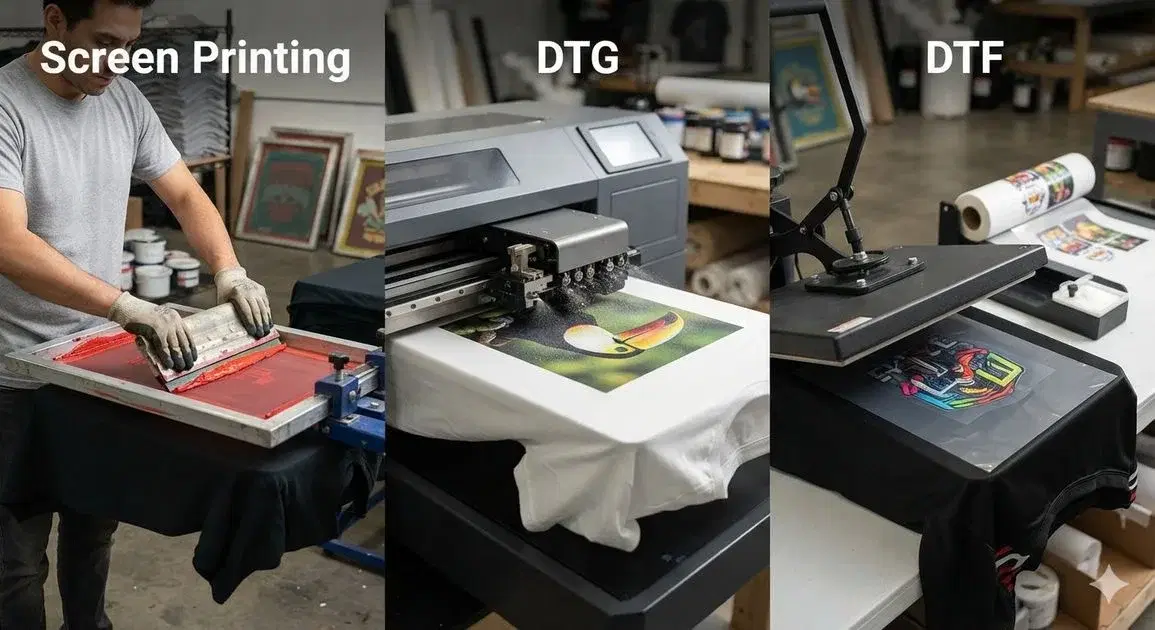
How it works. A stencil (a "screen") is made for each colour in your design. Ink is pushed through the mesh onto the fabric with a squeegee, one colour at a time, then heat-cured.
What it is genuinely best at
Bulk. Once the screens exist, the 800th shirt costs the same to print as the 20th.
Durability. Properly cured plastisol will typically outlast the shirt.
Effects nothing else can do: puff, metallic, high-density, glow.
Fabric range. Cotton, polyester, blends, canvas, even nylon with the right additive.
Where it hurts
Every colour is another screen, another setup fee, another alignment step.
Gradients and photographs are awkward. Possible via halftones, but not its strength.
Small orders are brutally uneconomical.
Verdict: uniforms, event tees, merch runs, anything above 100 pieces with a simple mark.
DTG printing: the soft one
How it works. An industrial inkjet sprays water-based ink directly into the fibres of the garment. Dark shirts need a liquid pre-treatment first so the white underbase sits properly.
What it is genuinely best at
Detail. Photographs, fine gradients, unlimited colours, no extra cost per colour.
No minimum. One shirt is economically fine.
Hand feel. The ink sits in the fabric, not on it. On a good 100% cotton tee you can barely feel the print. Nothing else matches this.
Where it hurts
Cost climbs linearly. 300 shirts via DTG is slow and expensive.
Fabric is a hard constraint, not a preference. It wants 100% ring-spun cotton. High-cotton blends are acceptable. 100% polyester and moisture-wicking activewear do not work properly, because the ink has nothing to bond to.
Colours are slightly softer than DTF, and prints fade gently over many washes.
Verdict: premium cotton tees, small runs, brands where the feel of the garment is part of the product.
DTF printing: the flexible one
How it works. The design is printed onto a clear PET film, hot-melt adhesive powder is applied to the wet ink and cured, and the resulting transfer is heat-pressed onto the garment.
What it is genuinely best at
Fabric-agnostic. Cotton, polyester, triblends, spandex, nylon, fleece, leather, canvas. This is the whole point.
Opacity. Colours stay bright on black without a separate pre-treatment step.
Stretch and wash resistance are excellent on a well-made transfer.
No setup cost, so mixed designs in one order cost the same as one repeated design.
Where it hurts
Hand feel. It is a thin layer sitting on the fabric. You can feel it. Compared to DTG it feels slightly plasticky.
Breathability. A large solid block of DTF is effectively a sheet of plastic on the chest. Noticeable in Sri Lankan heat.
Quality varies wildly between suppliers. Cheap powder and under-curing are why you see DTF prints peel after five washes. Good DTF does not peel.
Verdict: activewear, jerseys, dark garments, blends, print-on-demand, anything under about 50 units.
The Sri Lanka picture
This is where the global guides stop being useful.
Screen printing here is world class and cheap. Sri Lanka's apparel export industry means large-scale screen printing capacity is everywhere, and the per-unit pricing at volume is hard to beat anywhere in the region. If you are ordering 500 uniforms, you are in a good country to be doing that.
The problem is the MOQ wall. Those same factories are built around volume, so an independent designer wanting 40 shirts often cannot get in the door, or gets quoted a setup fee that kills the project.
DTF has filled that gap fast. Over the last few years DTF setups have spread widely across Colombo and beyond. For a small brand it is now usually the most accessible option: low minimums, quick turnaround, and it handles polyester, which matters here, because tropical weather pushes local buyers toward moisture-wicking fabric that DTG simply cannot print.
DTG is the awkward one locally. The machines are humidity-sensitive and maintenance-heavy, which is not an ideal match for the climate. It exists, but expect fewer suppliers and higher prices than you would see quoted in US or European guides.
Five mistakes that cost people money
Choosing the method before choosing the fabric. Decide the garment first. If it is polyester, DTG is already out and the decision is made for you.
Screen printing a six-colour design on a 20-shirt order. Setup fees will exceed the cost of the shirts. Use DTF.
Printing a large solid rectangle in DTF. Break it up. Use halftones, outlines, or negative space so the garment can breathe.
Buying DTF on price alone. Ask the supplier for a wash-tested sample. A transfer that has survived 20 washes tells you more than any quote.
Not ordering a sample at all. On any order above about 30 pieces, one sample shirt is the cheapest insurance you will ever buy.
Frequently asked questions
Is DTF better than DTG?
For fabric range, colour opacity on dark garments, and low-volume flexibility, yes. For hand feel on 100% cotton, DTG is still better. They solve different problems.
Which printing method lasts the longest?
Properly cured screen printing, followed closely by good-quality DTF. DTG lasts well but fades more visibly over many washes.
What is the cheapest way to print 20 t-shirts?
DTF, in almost every case. Screen printing setup fees do not amortise over 20 units.
Can you print on polyester?
DTF and screen printing, yes. DTG, not reliably, because it is designed to bond with cotton fibres.
Does DTF peel off?
Good DTF does not. Peeling is a symptom of poor adhesive powder, under-curing, or an incorrect heat press setting. It is a supplier problem, not a technology problem.
Which method is best for small businesses in Sri Lanka?
DTF, for most. It has the lowest barrier to entry, handles the polyester and blends common in local activewear, and needs no minimum order.
So which one should you pick?
Answer three questions in order:
What fabric? Polyester, blend, or stretch means DTF. Cotton means keep going.
How many? Over 100 of one simple design means screen printing. Under that, keep going.
Does the feel of the print matter more than the punch of the colour? Yes means DTG. No means DTF.
Three questions, and the crowded field of "it depends" resolves into one answer.
Working on a clothing line? Salupata connects you with vetted Sri Lankan textile manufacturers and printers, including small-run DTF suppliers who will not quote you a 500-piece minimum. Browse custom apparel suppliers to get started.